What Do Women Entrepreneurs Need This Week to Be Successful?
Your life is full, and it will take all of your wisdom, experience, and strength to handle becoming a small business owner. Women entrepreneurs over 40 often carry the pressure of running a business while balancing family, finances, and personal responsibilities. The truth is, many women business owners focus on others’ needs and forget to pause and ask themselves an important question:
What do I need this week to be successful?
Asking yourself this simple question can change how you lead your business, manage your energy, and protect your peace.
Signs You Need a Weekly Self-Check-In
Constant exhaustion
Difficulty focusing
Feeling emotionally overwhelmed
Lack of business clarity
Trouble setting priorities
If any of these sounds familiar, it is time to do your self-check-in.
Why Self-Check-Ins Matter for Women Entrepreneurs
Many women small business owners carry more than just a workload. They also carry emotional labor, decision fatigue, and the constant pressure to keep everything together.
A weekly self-check-in is a simple habit where women entrepreneurs pause to evaluate their emotional, mental, physical, and business needs before planning their week.
According to the Global Entrepreneurship Monitor 2024/2025 Women’s Entrepreneurship Report, many women entrepreneurs cite lack of profitability, personal pressures, and financial challenges as major reasons for closing businesses.
A weekly self-check-in helps you move from reacting to leading with intention.
It shifts your mindset from thinking:
“How do I survive this week?” to
“How do I set myself up to succeed this week?”
This shift makes a real difference.
Success Starts Before the To-Do List
Many entrepreneurs begin their week focused on tasks instead of what truly matters.
Before you open your planner, answer emails, or post online, pause and check in with yourself.
Ask Yourself These Questions
What is draining my energy right now?
Maybe it is overcommitting. Maybe it is lack of sleep. Maybe it is trying to do everything alone.
You can only fix what you are willing to face.
What support do I need this week?
Asking for support is wise, not a sign of weakness.
You may need:
More rest
Better boundaries
Help with marketing
Quiet time to think
Encouragement from trusted people
Time away from social media
Be truthful with yourself.
What is the one thing that would make this week feel successful?
Not perfect. Not busy. Successful.
Sometimes success is landing a new client. Sometimes success is finally finishing one project. Sometimes success is simply protecting your mental health while staying consistent.
Why Women Entrepreneurs Should Stop Measuring Success by Exhaustion
Many women have learned to believe that being tired means they are working hard enough.
This belief can harm both your business and your well-being.
Being exhausted is not a business strategy.
Burnout does not make you more valuable.
The strongest business owners are not those who do everything alone. They are the ones who manage their energy, set priorities, and stay focused.
Allow Yourself to Adjust
Your needs may change every week.
One week you may need discipline. The next week you may need rest. Another week you may need clarity, courage, or confidence.
Self-awareness helps you respond to your current situation instead of forcing yourself to work the same way every week.
Being flexible is a strength.
Create a Weekly Success Reset Routine
You can use this simple process every Sunday evening or Monday morning.
Step 1: Pause for 10 Minutes
Sit quietly without distractions.
No emails. No scrolling. No multitasking.
Step 2: Write Down Your Honest Answers
Ask yourself:
What do I need this week to feel focused?
What do I need emotionally?
What do I need physically?
What do I need financially?
What do I need spiritually?
Step 3: Choose Three Priorities
Not ten. Three.
Having clear priorities helps you feel less overwhelmed and make better decisions.
Step 4: Protect What Matters
Set aside time on your calendar for the things that help you succeed.
If rest matters, schedule it. If marketing matters, schedule it. If prayer, exercise, or family time are important to you, make sure to protect that time.
Women entrepreneurs over 40 have a unique kind of power
Building a business at this stage of life is powerful in its own way.
You know who you are. You value purpose over performance. You understand that PEACE IS PART OF SUCCESS.
You no longer have to prove your worth through constant hustle.
You can lead your business with wisdom, intention, and purpose.
Sometimes, the most productive thing you can do is pause and ask yourself:
What do I need this week to be successful?
Your answer might be the breakthrough you have been looking for. Before your week gets busy, pause and ask yourself: “What do I need to be successful this week?” Write down your answer, choose three priorities that support it, and build your week around what truly matters instead of what simply keeps you busy. Be Blessed.
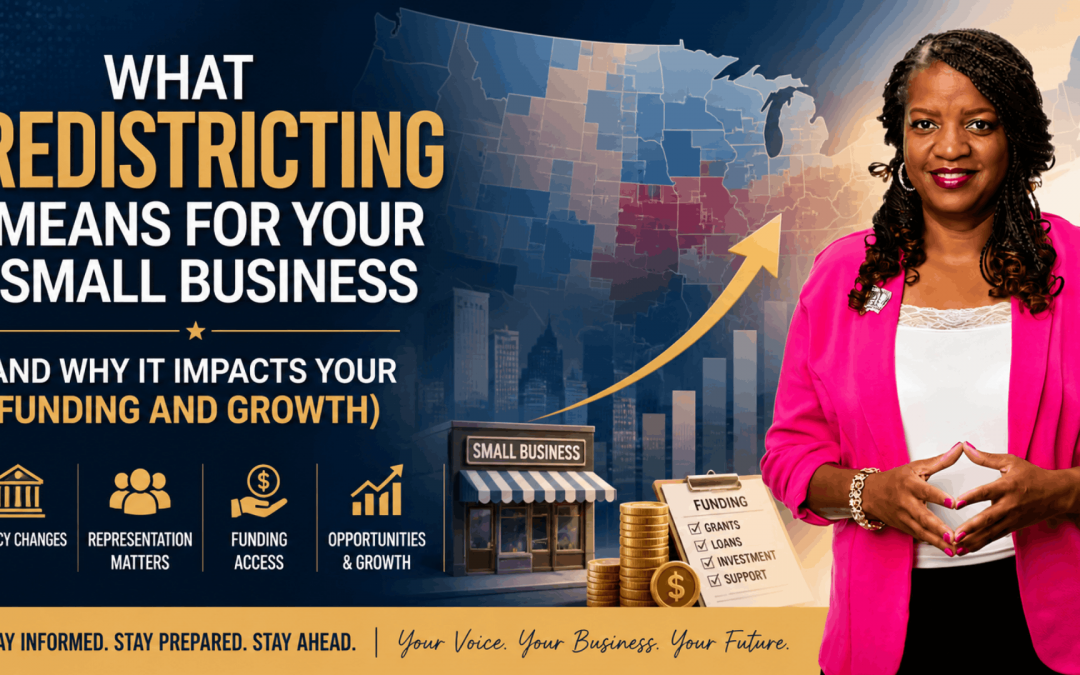
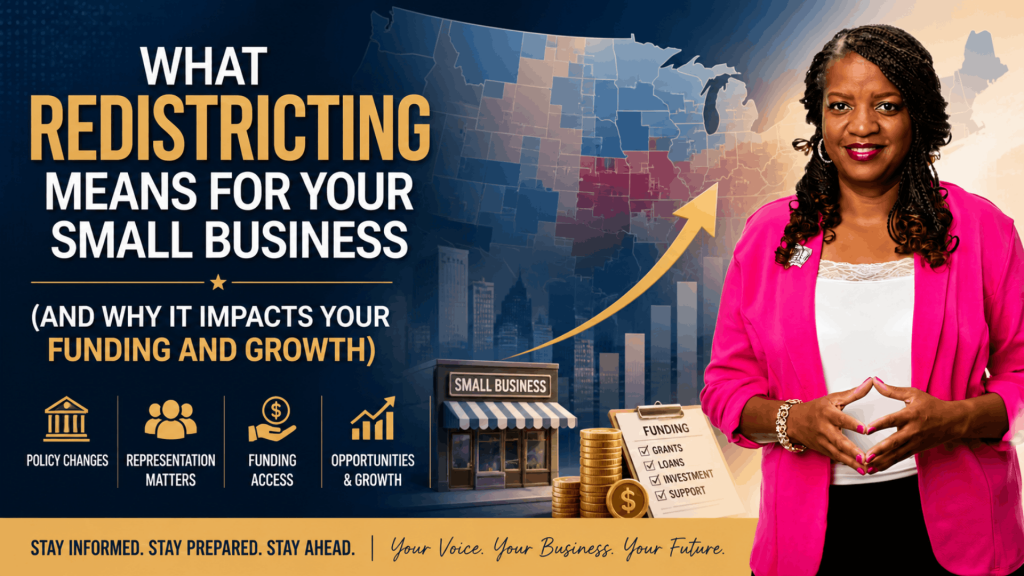
What Redistricting Means for Your Small Business (And Why It Impacts Your Funding and Growth)
Why Women Business Owners Over 40 Should Pay Attention
Most small business owners ignore redistricting because it feels political. The reality is, it directly impacts your funding, visibility, and opportunities.
Now, here is the truth many people miss.
Political decisions, especially those tied to voting laws and redistricting, shape the environment in which your business operates. They influence funding, policies, and who speaks for your community.
Understanding these decisions is essential because they affect your bottom line, your access to funding, and your ability to attract customers and contracts.
For years, there was a system in place to protect fairness when voting maps were drawn.
That system required certain states to get federal approval before changing district lines. This process was called preclearance. This process was one of the most powerful enforcement tools in the law. Today, that protection is no longer active, which means changes can happen without federal approval.
This change shifted the mix of voters, priorities, and representation.
For a small business owner, that can mean:
Different funding priorities
Less focus on certain industries
New relationships you must build
Even though businesses did not move, their business environment changed.
Strategic Insight: When your district changes, your business is effectively operating in a new market, even if your location stays the same. The advantage goes to those who quickly understand new priorities and reposition accordingly.
How Redistricting Connects to Your Business
1. Your Representation Shapes Your Opportunities
Your elected officials influence key areas such as:
Small business grants
Local development funding
Regulations and taxes
When your district changes, your representative often changes too. That means new priorities and new focus areas.
2. Policy Priorities Shift With New Districts
Elected leaders respond to the people in their district.
If your district becomes more:
Rural
Urban
Military-focused
Industry-specific
Then policies will reflect those priorities.
That can affect:
Which businesses get support
What industries receive funding
How resources are distributed
Strategic Insight: When district priorities shift, advantage goes to businesses that reposition early, before funding, partnerships, and visibility fully realign.
3. Access to Funding Can Change
Funding follows influence, so when districts shift, some communities gain visibility and opportunities while others lose them.
Research shows that areas with strong political representation often receive more targeted resources. That includes economic development programs and infrastructure investment.
Strategic Insight: Representation drives resource flow. When political influence shifts, funding follows, and businesses aligned with that movement gain disproportionate access to opportunities.
This increase changed representation, directly impacting where money, policy, and opportunity were directed. The key lesson is simple. When representation changes, money and opportunity follow. Smart business owners pay attention early, not after the shift happens.
What This Means for Women Business Owners Over 40
Redistricting can create challenges. However, women business owners over 40 also bring established experience and decision-making maturity, which becomes a strategic advantage in shifting policy environments.
1. Relationship Disruption
You may have built connections with local leaders or programs. After redistricting:
Those connections may no longer serve your district.
You may need to build new relationships.
Strategic Insight: Redistricting resets influence networks. Businesses that rebuild relationships quickly with new decision-makers regain momentum while others lose visibility.
2. Reduced Visibility in Larger Districts
If your community becomes part of a larger, less competitive district, your needs may receive less attention.
Your business may not be prioritized.
Strategic Insight: As districts expand, attention becomes more competitive. Businesses that increase their visibility and engagement intentionally are the ones that remain prioritized.
3. Shifts in Support Programs
Programs that support:
Women entrepreneurs
Small business growth
Workforce development
Funding for these programs may change depending on district priorities.
Strategic Insight: Support programs do not disappear overnight, they quietly redirect. Businesses that track these shifts early secure access while others are still unaware.
Additional Considerations for Minority and Women-Owned Businesses
Access to Capital
Many funding opportunities depend on:
Government programs
Policy priorities
Advocacy
If your community has less influence after redistricting, access to these resources can become more limited. Because legal protections for district design are now more limited, communities that once relied on them may have less influence over funding and policy decisions.
Strategic Insight: Access to capital follows influence, not just eligibility. Businesses that actively align with emerging policy priorities and advocacy networks position themselves where funding is directed, not where it used to be.
Advocacy and Representation
Minority and women-owned businesses often benefit from:
Collective advocacy
Representation in leadership
If district lines reduce that collective influence, your voice may not carry as strongly. This can lead to fewer contracts, fewer funding opportunities, and less visibility in your market.
Strategic Insight: Influence is rarely individual in policy-driven environments. Businesses that align with collective advocacy groups amplify their access, credibility, and negotiating power.
Market Opportunities
Public contracts and partnerships are often tied to:
Regional investment
Policy direction
A shift in district priorities can change who receives key opportunities.
Strategic Insight: Policy changes reshape markets unevenly. The businesses that win are those that anticipate where attention and investment are moving next, not where they have been.
How to Stay Positioned and Protected
Stay Informed
Know your district and your representative. This helps you understand where decisions are coming from.
Build New Relationships
Connect with your current representative’s office, local economic development groups, and your chamber of commerce to stay informed about opportunities.
Stay Visible
Attend local meetings, networking events, and business forums where decisions and funding opportunities are discussed.
Collaborate
Partner with other women and minority business owners. Collective voices are harder to ignore.
What This Ultimately Means
Redistricting may feel distant, but its impact is close and personal. It shapes who has access, who gets support, and who is seen.
As a woman business owner over 40, you already know how to adapt and lead. Understanding how redistricting affects your business allows you to position yourself with clarity and intention.
Redistricting is not just political. It is strategic. The business owners who understand it early position themselves to lead, not react.
Stay informed, do your research, and let your voice be heard.
If you found this helpful, share it with another business owner who needs to understand how these changes may impact their growth.
Build New Relationships
Connect with your current representative’s office, local economic development groups, and your chamber of commerce to stay informed about opportunities.
Stay Visible
Attend local meetings, networking events, and business forums where decisions and funding opportunities are discussed.
Collaborate
Partner with other women and minority business owners. Collective voices are harder to ignore.
What This Ultimately Means
Redistricting may feel distant, but its impact is close and personal. It shapes who has access, who gets support, and who is seen.
As a woman business owner over 40, you already know how to adapt and lead. Understanding how redistricting affects your business allows you to position yourself with clarity and intention.
Redistricting is not just political. It is strategic. The business owners who understand it early position themselves to lead, not react.
Stay informed, do your research, and let your voice be heard.
If you found this helpful, share it with another business owner who needs to understand how these changes may impact their growth.
Life Is Too Short to Settle: Why Your Age Is Your Greatest Business Asset
There is a pervasive myth in the business world that if you have not found your ultimate calling by a certain age, your window of opportunity has closed. Society often tells us to settle into comfort, coast toward retirement, and leave the bold moves to the next generation. As the Soul-Aligned Business Architect, I am here to tell you that this narrative is entirely backwards. Your accumulated years are not an expiration date on your dreams; they are the foundation of your future success. Life is simply too short to spend your days doing anything other than what sets your soul on fire.
To truly understand the power of this realization, we have to look at the undeniable proof that late-career pivots actually work. According to a comprehensive survey by the American Institute for Economic Research, 82 percent of respondents who attempted a career transition after age 45 were successful. This statistic proves that stepping into the unknown later in life is not a reckless gamble. It is a highly viable path to professional and personal fulfillment.
I’ve seen these numbers play out in my own life. After twenty years in the United States Marine Corps, I learned a lot about discipline, resilience, and getting things done. But when I retired, I realized my biggest mission was still ahead. I had to move from a set path to creating a life and business that matched my true purpose.
My own big change is why I’m passionate about helping others connect their work to what matters most. When you use your life experience in your career, you start to build something that really fits you. We all spend years learning, growing, and finding our voice. If you let fear stop you from starting over, you’re not just holding yourself back; you’re also keeping your unique gifts from those who need them.
To help people bring their full selves to their work, I created the TAPIN Method™. It all begins with changing how you think. You can’t build a meaningful, exciting business if you believe your best days are behind you. Let go of those doubts and see that your experience is your greatest strength.
When you recognize your own value, everything else becomes possible. Whether you want to write a book, start a ministry, or become a coach, the steps to success are much the same. You need to take action, use your strengths, and stop letting time slip by without doing what you really want.
Now is the time to stop waiting and begin your next chapter. If you want to discover your passion and build a business that fits who you are, I invite you to have a conversation. Let’s make this change together and turn your vision into reality. Send me a message today and take the first step toward doing what you love.
Alright, my phenomenal entrepreneurs! Brenda The Soulutionist here, and today, we’re tackling a subtle but powerful invisible cage that can hold us back: being a “Prisoner to Your Preferences.”
You know what I’m talking about. It’s the “I’ve always done it this way” mindset. The “I only like X color/platform/strategy.” The subtle resistance to new ideas, different approaches, or unexpected opportunities simply because they don’t fit our preconceived notions or comfort zones. We develop preferences, and without realizing it, like bars on a cage, they can become barriers to our entrepreneurial growth, limiting our impact.
Success, especially in our dynamic world, thrives on adaptability. It demands an openness to new information, a willingness to pivot, and the courage to step outside of what’s “familiar” or “preferred” if it means unlocking a greater level of breakthrough. Being a prisoner to your preferences means missed opportunities, stagnant growth, and a ceiling on your potential. God does not want you to be a public success and a private failure. To ensure your success in all aspects (spiritually, mentally, emotionally, financially, and physically), you must first be honest with yourself.
Are you ready to break free and embrace the expansive possibilities that change offers? Let’s unlock that freedom!
3 Tips to Break Free and Be Open to Change:
1. Question Your “Why” (The Root of Your Preference):
Tip: When you find yourself resistant to a new idea, strategy, or even a different tool, pause and ask: “Why do I prefer the old way so strongly? Is it truly more effective, or is it just more comfortable/familiar?” Dig deeper than the surface-level answer. Is it fear of the unknown? A past negative experience? An outdated belief?
Why it works: Many preferences are based on comfort, fear, or limited past information, rather than current logic or optimal strategy. When you question the “why,” you begin to dismantle the emotional attachment and open up space for rational evaluation, allowing you to get real with yourself.
Tip: Instead of fully committing to or rejecting a new approach, commit to testing it. Choose one small, low-risk way to try something different that challenges a preference. For example, if you prefer only one social media platform, try posting valuable content on another for a week. If you prefer a certain workflow, try a different sequence for one project.
Why it works: This reduces the perceived risk of change. You’re not abandoning your preference entirely; you’re simply gathering data. Often, these small tests reveal unexpected benefits or prove that the “new” way isn’t as intimidating as you thought, building confidence for larger pivots.
3. Seek Diverse Perspectives (The “Outside Eyes” Strategy):
Tip: Intentionally seek out opinions and experiences from people who don’t share your preferences or who have successfully navigated the change you’re resisting. Choose a coach, a mentor, a peer in a different industry, or even a trusted client to gather a different point of view. Ask them about their experiences, challenges, and successes with alternative approaches.
Why it works: We all have blind spots. Fresh, external perspectives can highlight opportunities you missed, challenge limiting beliefs you hold, and provide valuable insights that break down your resistance. It expands your view beyond your own “cage of preference” and can help ensure your success in all areas: spiritually, mentally, emotionally, financially, and physically.
Remember, true freedom in entrepreneurship comes from being agile, adaptable, and forever curious. Don’t let your comfort zone become your confinement. Break free from those preferences, and watch your business and your life expand in ways you never imagined! Be blessed and protect your peace.
Unlock Next-Level Growth: Your End-of-Quarter Power Checklist for Entrepreneurs
Alright, Power Players! Brenda, The Soulutionist here, and as we wrap up this quarter, it’s not just about crossing the finish line – it’s about crushing your quarterly business review to set yourself up for even more incredible growth. This entrepreneur’s checklist is your easy-to-use guide to celebrating wins, extracting powerful lessons, and sharpening your business growth strategy for monumental impact. Let’s dive in and transform your reflection into unstoppable momentum!
1. Reflect & Celebrate Your Journey: Building a Growth Mindset
Review Your Goals: Pull out those goals you set at the beginning of the quarter. Did you hit them? Exceed them? Fall a little short? There is no judgment here, just data!
Acknowledge Your Wins: Big or small, what did you accomplish? Did you land a new client, launch a new product, master a new skill, or show up consistently? Write them down and truly celebrate them. You earned it!
Identify Your Lessons Learned: What didn’t go as planned? What challenges did you face? More importantly, what did those experiences teach you? Every “setback” is a lesson in disguise.
Client & Customer Wins: How did your clients or customers benefit from your work this quarter? Gather any testimonials, positive feedback, or success stories.
2. Financial Flow & Foundations: Mastering Your Business Financial Health
Income & Expense Review: Take a good look at your numbers. What was your total income? What were your biggest expenses? Are there any areas where you can optimize?
Invoicing & Payments: Have all your invoices been sent? Are all outstanding payments collected? Don’t leave money on the table!
Profitability Check:How profitable was this quarter? Understanding your margins helps you make smarter decisions in the future.
Budget Alignment: Did you stick to your budget? If not, what adjustments will you make for next quarter?
3. Operational Excellence & Efficiency: Your Productivity & Systems Audit
Systems & Processes Audit: Are your current systems working smoothly? Is there anything that consistently causes friction or takes up too much time?
Task Delegation & Automation: What tasks can you delegate or automate to free up your energy and time for higher-level work?
Software & Tools Review: Are you getting the most out of your current tools? Are there any subscriptions you’re paying for but not using?
Content & Marketing Review: What content performed well? What marketing efforts brought in leads or sales? What can be refined or repurposed?
4. Planning for Profitable Progress: Strategic Goal Setting for Your Business
Q3 Vision & Goals: Based on your review, what are your clear, measurable goals for the next quarter? Be specific and realistic, but don’t be afraid to dream big!
Key Projects & Priorities: What are the 1-3 major projects that will move your business forward next quarter?
Marketing & Sales Strategy: What’s your plan for attracting new clients/customers and nurturing existing ones?
Learning & Growth: What new skills do you want to develop? What knowledge do you need to acquire to hit your next-quarter goals?
Self-Care & Energy: How will you intentionally build in time for rest, rejuvenation, and personal growth? Remember, you are your most valuable asset!
As a reminder, you cannot manage what you do not measure. This checklist is your compass for greater business growth and sustainable success. I know you’re capable of incredible things! Let’s make the next quarter your most impactful yet! Now, I want to hear from you! Which section of this End-of-Quarter Power Checklist are you most excited to tackle first, and why? Share your commitment in the comments below! Be blessed, and as always, protect your peace.