What Redistricting Means for Your Small Business (And Why It Impacts Your Funding and Growth)
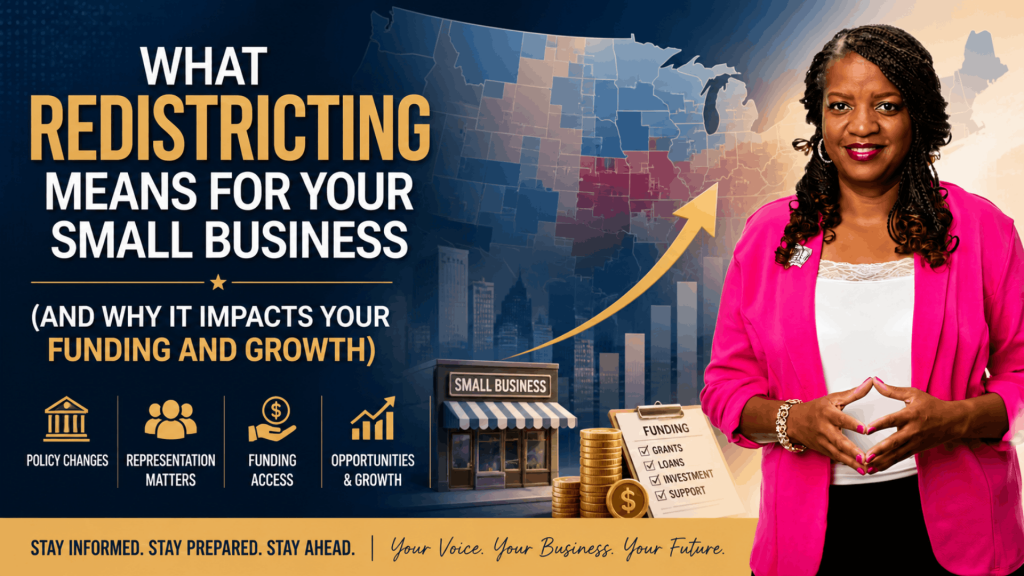
What Redistricting Means for Your Small Business (And Why It Impacts Your Funding and Growth)
Why Women Business Owners Over 40 Should Pay Attention
Most small business owners ignore redistricting because it feels political.
The reality is, it directly impacts your funding, visibility, and opportunities.
Now, here is the truth many people miss.
Political decisions, especially those tied to voting laws and redistricting, shape the environment in which your business operates. They influence funding, policies, and who speaks for your community.
Understanding these decisions is essential because they affect your bottom line, your access to funding, and your ability to attract customers and contracts.
What Changed With the Supreme Court and the Voting Rights Act
For years, there was a system in place to protect fairness when voting maps were drawn.
That system required certain states to get federal approval before changing district lines. This process was called preclearance. This process was one of the most powerful enforcement tools in the law. Today, that protection is no longer active, which means changes can happen without federal approval.
Then everything shifted.
First Shift: Shelby County v. Holder (2013)
In Shelby County v. Holder, the Supreme Court removed the formula that enforced preclearance.
Here is what that means in simple terms:
- States no longer need federal approval before changing voting maps.
- Redistricting can happen faster.
- Problems are challenged after the damage is already done.
Second Shift: Louisiana v. Callais (2026)
Then came Louisiana v. Callais.
This decision made it harder to challenge district maps, especially when the issue is how those maps impact communities.
Now:
- It is harder to prove discrimination unless the intent is clear.
- Courts are less likely to require districts to protect minority voting strength.
- Legal challenges take longer and face higher barriers.
What Is Redistricting in Simple Terms
Redistricting is the process of drawing the lines that decide:
- Who represents you
- Which communities are grouped together
- How political power is distributed
When those lines change, your business environment can change with them.
Real Example: What this Looks Like in my Hometown of Goldsboro, NC
In Goldsboro, recent redistricting moved the area from one congressional district to another.
This change shifted the mix of voters, priorities, and representation.
For a small business owner, that can mean:
- Different funding priorities
- Less focus on certain industries
- New relationships you must build
Even though businesses did not move, their business environment changed.
Strategic Insight: When your district changes, your business is effectively operating in a new market, even if your location stays the same. The advantage goes to those who quickly understand new priorities and reposition accordingly.
How Redistricting Connects to Your Business
1. Your Representation Shapes Your Opportunities
Your elected officials influence key areas such as:
- Small business grants
- Local development funding
- Regulations and taxes
When your district changes, your representative often changes too. That means new priorities and new focus areas.
2. Policy Priorities Shift With New Districts
Elected leaders respond to the people in their district.
If your district becomes more:
- Rural
- Urban
- Military-focused
- Industry-specific
Then policies will reflect those priorities.
That can affect:
- Which businesses get support
- What industries receive funding
- How resources are distributed
Strategic Insight: When district priorities shift, advantage goes to businesses that reposition early, before funding, partnerships, and visibility fully realign.
3. Access to Funding Can Change
Funding follows influence, so when districts shift, some communities gain visibility and opportunities while others lose them.
Research shows that areas with strong political representation often receive more targeted resources. That includes economic development programs and infrastructure investment.
Strategic Insight: Representation drives resource flow. When political influence shifts, funding follows, and businesses aligned with that movement gain disproportionate access to opportunities.
A Statistic That Shows Why This Matters
After the Voting Rights Act was enforced, Black voter registration in Mississippi increased from fewer than 7 percent in 1965 to 59 percent by 1967.
This increase changed representation, directly impacting where money, policy, and opportunity were directed. The key lesson is simple. When representation changes, money and opportunity follow. Smart business owners pay attention early, not after the shift happens.
What This Means for Women Business Owners Over 40
Redistricting can create challenges. However, women business owners over 40 also bring established experience and decision-making maturity, which becomes a strategic advantage in shifting policy environments.
1. Relationship Disruption
You may have built connections with local leaders or programs. After redistricting:
- Those connections may no longer serve your district.
- You may need to build new relationships.
Strategic Insight: Redistricting resets influence networks. Businesses that rebuild relationships quickly with new decision-makers regain momentum while others lose visibility.
2. Reduced Visibility in Larger Districts
If your community becomes part of a larger, less competitive district, your needs may receive less attention.
- Your business may not be prioritized.
Strategic Insight: As districts expand, attention becomes more competitive. Businesses that increase their visibility and engagement intentionally are the ones that remain prioritized.
3. Shifts in Support Programs
Programs that support:
- Women entrepreneurs
- Small business growth
- Workforce development
Funding for these programs may change depending on district priorities.
Strategic Insight: Support programs do not disappear overnight, they quietly redirect. Businesses that track these shifts early secure access while others are still unaware.
Additional Considerations for Minority and Women-Owned Businesses
Access to Capital
Many funding opportunities depend on:
- Government programs
- Policy priorities
- Advocacy
If your community has less influence after redistricting, access to these resources can become more limited. Because legal protections for district design are now more limited, communities that once relied on them may have less influence over funding and policy decisions.
Strategic Insight: Access to capital follows influence, not just eligibility. Businesses that actively align with emerging policy priorities and advocacy networks position themselves where funding is directed, not where it used to be.
Advocacy and Representation
Minority and women-owned businesses often benefit from:
- Collective advocacy
- Representation in leadership
If district lines reduce that collective influence, your voice may not carry as strongly. This can lead to fewer contracts, fewer funding opportunities, and less visibility in your market.
Strategic Insight: Influence is rarely individual in policy-driven environments. Businesses that align with collective advocacy groups amplify their access, credibility, and negotiating power.
Market Opportunities
Public contracts and partnerships are often tied to:
- Regional investment
- Policy direction
A shift in district priorities can change who receives key opportunities.
Strategic Insight: Policy changes reshape markets unevenly. The businesses that win are those that anticipate where attention and investment are moving next, not where they have been.
How to Stay Positioned and Protected
Stay Informed
Know your district and your representative. This helps you understand where decisions are coming from.
Build New Relationships
Connect with your current representative’s office, local economic development groups, and your chamber of commerce to stay informed about opportunities.
Stay Visible
Attend local meetings, networking events, and business forums where decisions and funding opportunities are discussed.
Collaborate
Partner with other women and minority business owners. Collective voices are harder to ignore.
What This Ultimately Means
Redistricting may feel distant, but its impact is close and personal. It shapes who has access, who gets support, and who is seen.
As a woman business owner over 40, you already know how to adapt and lead. Understanding how redistricting affects your business allows you to position yourself with clarity and intention.
Redistricting is not just political. It is strategic.
The business owners who understand it early position themselves to lead, not react.
Stay informed, do your research, and let your voice be heard.
If you found this helpful, share it with another business owner who needs to understand how these changes may impact their growth.
Build New Relationships
Connect with your current representative’s office, local economic development groups, and your chamber of commerce to stay informed about opportunities.
Stay Visible
Attend local meetings, networking events, and business forums where decisions and funding opportunities are discussed.
Collaborate
Partner with other women and minority business owners. Collective voices are harder to ignore.
What This Ultimately Means
Redistricting may feel distant, but its impact is close and personal. It shapes who has access, who gets support, and who is seen.
As a woman business owner over 40, you already know how to adapt and lead. Understanding how redistricting affects your business allows you to position yourself with clarity and intention.
Redistricting is not just political. It is strategic.
The business owners who understand it early position themselves to lead, not react.
Stay informed, do your research, and let your voice be heard.
If you found this helpful, share it with another business owner who needs to understand how these changes may impact their growth.